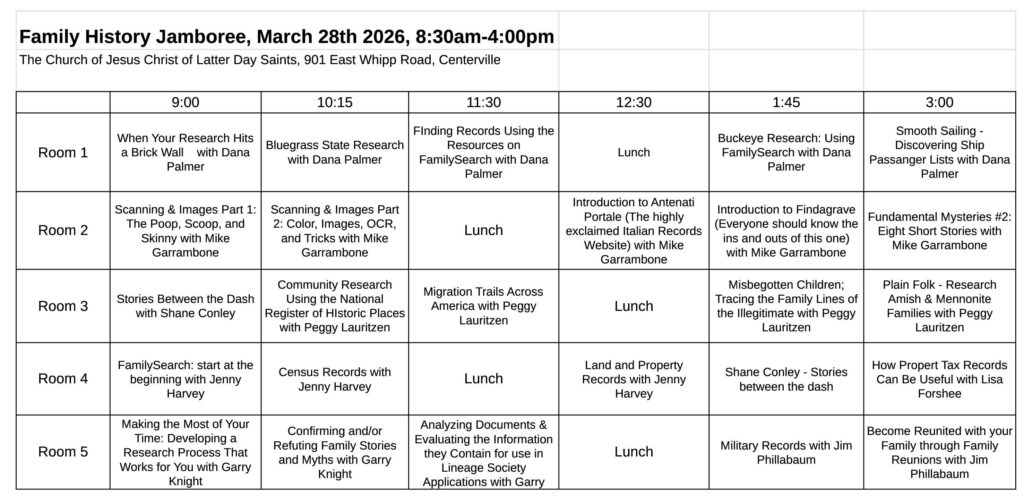
The class list for 2026 is finalized.
Click here for a printable version of the schedule.
Class descriptions and instructors are listed below.
Head over to the “downloads” page to download the syllabus/handouts for each class.
Electronic devices are welcome in all classes
Stories Between the Dash
with Shane Conley
Class Description: This class workshop will show various research techniques used to uncover the unusual resources and help finding documents on individual ancestors. Learn about ancestors’ social activities, bringing their narrative to live and connecting their experience to other relatable occurrences from their time in the community. Create a story line and how to share what you have found with others.
How Property Tax Records Can Be Useful
with Lisa Forshee
Class Description: Property tax records give us snapshots of events that took place between census’. We can learn if our ancestors owned land, estimate their years of birth & death, can assist us in identifying names of family members and much more. Most importantly, they can help us break through brick walls!
Think you know Family Search?
with Jenny Harvey
Class Description: Come with me as we explore every tab on family
search. Let’s explore the magical FamilySearch Wiki, the immense catalogue, and the memories tab. Learn how to narrow down your searches, and how to use the new AI full text search.
Let’s Explore Census Records
with Jenny Harvey
Class Description: In this class we will explore the US census records
and census substitutes. Learn what censuses are available and where, why a census survey is an important place to start your research and see how census records lead us
to other records.
Land & Property Records
with Jenny Harvey
Class Description: This class introduces how to use land and property records as effective tools in research. Participants will explore the different types of land records, the kinds of information they contain, and how that information can be applied to historical or genealogical research. The class also covers major sources for locating land records, including Bureau of Land Management (BLM) records and online resources for individual state land record collections.
Analyzing Documents & Evaluating the Information They Contain for Use in Lineage Society Applications
with Garry Knight
Class Description: Applying to lineage societies can be overwhelming when you combine completing the application and sorting through the numerous supporting documents to accompany the application. Learn how to analyze various documents and evaluate the information they provide and simplify your lineage society application process.
Making the Most of Your Time: Developing a Research Process That Works for You
with Garry Knight
Class Description: Many of us have busy lives and little time for research. Learn how to make the most of your limited time by developing a flexible research process that can be utilized to investigate multiple fields of study.
Confirming and/or Refuting a Family Stories and Myths
with Garry Knight
Class Description: Family stories are often problematic for genealogists. They can be difficult to prove or refute for various reasons including their creation as designed to obfuscate embarrassing situations and the tendency of these stories to change and become exaggerated over time. Learn how to use critical thinking, experience and a sound research process to search for the facts and make a determination on the stories validity.
When Your Research Hits a Brick Wall
with Dana Palmer, CG®, CGL(SM)
Class Description: Have you ever hit a genealogy brick wall? Come learn techniques to help you bust your brick walls and discover your family.
Bluegrass State Research
with with Dana Palmer, CG®, CGL(SM)
Class Description: Changing boundaries and loss of records make finding family in Kentucky challenging. Learn tricks to overcome these obstacles and find your Kentucky kin.
Finding Records Using the Resources on FamilySearch
with Dana Palmer, CG®, CGL(SM)
Class Description: Many records exists online and in repositories. Learn how to use the resources on FamilySearch to find them.
Buckey Research: Using FamilySearch
with Dana Palmer, CG®, CGL(SM)
Class Description: FamilySearch has a treasure trove of Ohio records for genealogists. Come learn how to access these records.
Smooth Sailing – Discovering Ship Passenger lists
with Dana Palmer, CG®, CGL(SM)
Class Description: Learn how to be successful finding your ancestors in ship passenger lists.
Military Records
with Jim Phillabaum
Class Description: Covers U.S. Military Records from Revolutionary War to the present. Location of records; how to apply for copies;
what you can expect to find. Also explores non-traditional methods of obtaining records.
Family Reunions
with Jim Phillabaum
Class Description: Discover how a family reunion can help you in your research efforts.
Community Research Using the National Register of Historic Places
with Peggy Lauritzen
Class Description: A few years ago two genealogists met over lunch to discuss a common genealogy dilemma. The ideas began tumbling around, and soon each was using a different site to solve a research question. This presentation will take you through the steps of discovering the areas where you ancestors may have lived, and the necessary proof to have them registered. Those historic markers by the side of the road may contain a history of the area they lived, and perhaps even mention them by name.
Migration Trails Across America
with Peggy Lauritzen
Class Description: This presentation concentrates on the most common means of travel in the New World. Migrations trails and patterns will be discussed, as well as the many rivers and canals that interconnected us as a nation. A case study will be demonstrated showing a “lost” ancestor”.
Misbegotten Children; Tracing the Family Lines of the Illegitimate
with Peggy Lauritzen
Class Description: Nearly all families have children with seemingly missing fathers. Yet, there may be clues and resources to help us determine their ancestry. Illegitimacy can be both a surprise and an embarrassment as we discover more and more about our family’s history. Treated with care and sensitivity, we can use many available resources to help us in our research.
Plain Folk – Research Amish & Mennonite Families
with Peggy Lauritzen
Class Description: Amish and Mennonite families are often romanticized in modern literature and television series. However, their backgrounds, though similar, have beliefs that keep them separate. The Amish and the Mennonites are often grouped together. And, while they have some similarities, including their roots in religion, there are distinct differences.
Scanning & Images Part 1: The Poop, Scoop, and Skinny
with Mike Garrambone
Class Description: This is the class that everyone wants to attend because knowing about scanning and images can make your genealogy work visually pleasing and exciting to see. We start out with all ideas from a novice’s standpoint and discuss the basics of scanning. Next we talk about the colorful images that we can use every day in genealogy. We discuss the major types of images and show examples that make selecting file formats much easier to do. We illustrate many ideas on changing images and getting them into your documents and presentations. We show lots of examples and everything is geared to a first time beginner that wants to add “pizzazz” to their work. This presentation talks about the very simple ideas you need to know in order to make use of scanners and putting your images into printed documents and displays. We will talk about machines, images sources, and editing that can bring wonders to
your displays of family history.
Scanning & Images Part 2: Color, Images, OCR, and Tricks
with Mike Garrambone
Class Description: This is the second lesson on scanning and images that explores several additional and very interesting topics to help you get those colorful items into your genealogy documents. We begin with a short review and talk about images, their sizes and shapes, and their appearance in your computer, on your electronic screens, and lastly coming out of various color printers. Like the first lesson, we will again discuss the common file formats and what might be best for your purposes. We will talk about how images show up on screens and then demonstrate a variety of tricks you can use to make changes to your images to better fit your needs. We will introduce text, OCR and PDF; stretching and compressing, and how those image editors and
PowerPoint can be used to manipulate those colorful dots..
Introduction to Antenati Portale
(The highly exclaimed Italian Records Website)
with Mike Garrambone
Class Description: Antenati Portale is a free online Italian government data repository of civil vital records, church (ecclesiastical) documents, and other nationally retained files that are available at the Italian province-level archives. This presentation describes what the online website looks like, the documents stored and indexed there, and the methods you can use to find your own documents. You will enjoy learning through clearly explained examples on how to find exactly what you are searching for and what is currently available. The tricks and insights are free.
Introduction to Findagrave
(Everyone should know the ins and outs of this one)
with Mike Garrambone
Class Description: Findagrave is a genealogical website and the best place on the internet to look for burial and other deceased information. This free website is huge and growing, contains unique data, and may provide outstanding images and important family information. This presentation will show you what Findagrave has to offer, what information is available, and how to get it. The interesting examples will strengthen your background in genealogy and allow you to tell stories about your own family. You will learn the website’s demands and useful techniques and tricks to always get good research results.
Fundamental Mysteries #2: Eight Short Stories
with Mike Garrambone
Class Description: If you caught any of the Fundamental Mysteries presentations, then you are ready for more. If you didn’t, no problem, since they are all standalones, but… and just as mysterious. The idea remains that genealogists know there are some fundamental ways of research that will help them make their most wonderful finds. These ideas are so simple and are always over looked but could make tremendous contributions to their research. In a storyteller fashion, these eight stories will describe how to make interesting discoveries. You will hear about those enlightened thoughts and the hidden quirks that provided those wonderful break-throughs that researchers all embrace. Again, no smoke, no mirrors, just more fundamental Mysteries and amazing ideas for you to learn about and enjoy.